
For the past decade, Hong Kong has attracted global investors primarily through its competitive simple tax system. However, as we move into 2026, the full implementation of the Global Minimum Tax has fundamentally challenged traditional offshore tax-saving models.
The Financial Leverage of R&D: ‘Turning $1 into $3’
In modern financial planning, R&D investment is more than a line item on a P&L statement; it is a high-efficiency tax shield. The Tiered Super Deduction implemented by the Hong Kong Inland Revenue Department (IRD) significantly lowers the net cost of innovation by amplifying deductible expenses.
Tiered Deduction Structure and Quantitative Analysis
Qualified R&D expenditures are eligible for a two-tiered deduction with no ceiling on the super-deduction amount:
-
First HKD 2 Million: Eligible for a 300% deduction (Every $1 spent offsets $3 of taxable profit).
-
Remaining Balance: Eligible for a 200% deduction (Every $1 spent offsets $2 of taxable profit).
Case Study: If a company invests HKD 5,000,000 in qualified R&D within a fiscal year, the total tax deduction is calculated as follows:
Total Deduction = (2,000,000 * 300%) + (3,000,000 * 200%) = 12,000,000 HKD
Determining Eligibility: Is Your Expenditure Qualified?
To access these incentives, enterprises must meet three fundamental criteria:
- Locality: The R&D activities must be conducted within Hong Kong.
- Technical Objective: The project must aim for a ‘Significant Advance’; routine product design or cosmetic development does not qualify.
-
Execution: Activities must be performed in-house or outsourced to Designated Local Research Institutions (a list of which is available on government websites).
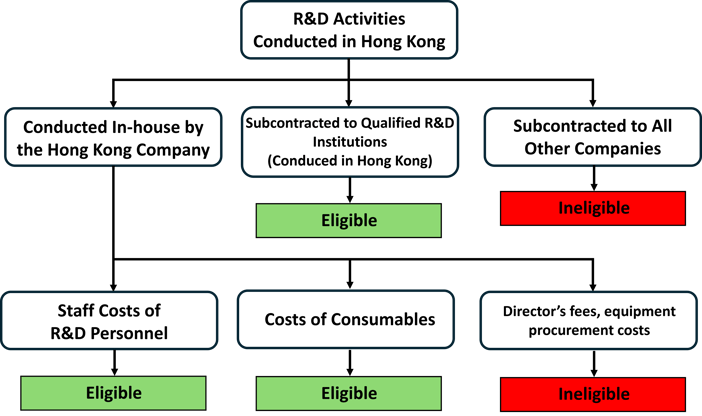
Even if basic criteria are met, the IRD strictly categorizes expenses into Type A and Type B.
-
Type B (Super-Deductible): Includes staff costs for R&D personnel and consumables directly used in the process. These enjoy the 200%-300% rates.
-
Type A (Standard Deduction): Includes director’s fees, administrative overheads, and capital expenditure on equipment. These are limited to a 100% standard deduction.
| R&D Activities | |||
| Conducted in Hong Kong | Conducted Outside Hong Kong | ||
| Conducted in-house by the Hong Kong company | Outsourced to qualified local research institutions | Outsourced to any other institutions | |
| Staff costs for R&D and seconded/assigned personnel; Consumables | Other expenditures (e.g., directors' emoluments, purchase of equipment) | ||
| Type B (300% / 200%) | Type A (100%) | Type B (300% / 200%) | Type A (100%) |
A common audit misconception is that a patent must be granted or an intangible asset must be capitalized to claim the deduction. In reality, the policy rewards the R&D Activity itself. As long as the project pursues a technical breakthrough, expenses remain eligible even if the R&D is ultimately unsuccessful or not capitalized for commercial reasons.
Navigating HK-Mainland Cross-Border R&D
For multinational investors, the 'HK R&D Hub + Mainland Development Team' model has become the benchmark for China market entry. A pivotal challenge within this hybrid structure is maximizing tax deductions while ensuring cross-border compliance.
To address these complexities, the Hetao Shenzhen-Hong Kong Science and Technology Innovation Cooperation Zone offers a unique strategic advantage. Positioned as a major cooperative platform under China’s 14th Five-Year Plan, the zone operates under a 'One River, Two Banks' and 'One Zone, Two Parks' framework. Spanning 0.87 $km^2$ in Hong Kong and 3.02 $km^2$ in Shenzhen, it focuses on Life Sciences, Information Science, and Material Sciences—creating a world-class hub for international innovation and high-tech synergy.
While policy mandates that R&D be conducted in Hong Kong, compliance can be optimized through robust structural planning. The core logic is to ensure that lead functions, critical technical decision-making, and key personnel remain within the Hong Kong entity. While payments to non-qualified offshore affiliates are generally restricted to a 100% deduction, the Hong Kong-based portion can still secure the 300% super-bonus, provided there is a complete evidentiary chain, such as detailed timesheets.
The Patent Box: 5% Preferential Tax Rate and IP Optimization
The Patent Box provides a deep tax discount on profits derived from qualified IP generated through R&D in Hong Kong.
1. Broadening the Definition of Qualified Assets
The scope extends far beyond traditional patents to include:
- Patents & Equivalent Assets: Legally protected patents and assets under similar approval processes.
- Copyrighted Software: A major draw for FinTech and AI investors.
- Plant Variety Rights: Rights granted under the Plant Varieties Protection Ordinance.
Requirement: These assets must meet ‘In-force Registration’ standards, such as being registered through the Hong Kong Original Grant Patent (OGP) system.
2. The 5% Rate and the ‘Nexus Ratio’
Qualified IP profits are taxed at a preferential rate of 5%, significantly lower than the standard 16.5%. The application of this rate depends on the Nexus Ratio.
- Expenses must be directly related to the development of the IP asset.
- While acquisition costs of IP assets are excluded from the R&D expenditure base, the regime allows for a 30% uplift on qualified expenses to increase the proportion of income eligible for the 5% rate. This ensures that investors who acquire base tech and then innovate in Hong Kong can still maximize their tax benefits.
Conclusion: Embracing Strategic Certainty
In 2026, Hong Kong's tax value has evolved from ‘offshore evasion’ to ‘onshore strategic certainty.’ As BEPS 2.0 redefines global compliance, the most sustainable path for foreign investors is a proactive pivot toward the Patent Box and R&D Super Deductions.
To lock in these benefits, we recommend a ‘Compliance-First’ approach: prioritize local IP registration under OGP standards and maintain a meticulous audit trail—specifically project-based time-tracking for personnel. With over 18 years of cross-border expertise, the Hongda Team is dedicated to helping you navigate these transitions and unlock the true commercial value of your innovation.
Let us know if you have any questions and we'll be happy to reply, so leave them in the comments section below for us to answer!