
Let’s take a look at the preferential policies in this budget from the release of the Hong Kong government and see how much you can save in 2026-27.
For foreign investors seeking strategic deployment in the Asia-Pacific region, Hong Kong’s tax simplicity and free flow of capital are core attractions as an international financial center. In the latest "Budget" released on February 25, 2026, the Hong Kong government not only proposed tax concession measures for individuals but also adjusted stamp duty policies and significantly increased tax allowances.
Let’s take a look at the preferential policies in this budget. As a taxpayer in Hong Kong, how much can you save?
Reduction of Profits Tax, Salaries Tax, and Tax under Personal Assessment
The most notable tax measure in the budget is a one-time reduction of 100% of profits tax, salaries tax, and tax under personal assessment for the 2025/26 year of assessment, subject to a ceiling of $3,000 per case. According to the Hong Kong government's estimates, this measure will ‘benefit about 2.12 million taxpayers of salaries tax and tax under personal assessment and about 171,000 enterprises, reducing government revenue by about $5.8 billion.’
(1) Hong Kong Profits Tax
In the proposed measures, the ceiling for Profits Tax reduction is calculated for each business. In the practical operation of the Inland Revenue Department, the following are usually regarded as independent ‘businesses’:
- Different Limited Companies: Even if these companies have the same parent company or the same directors.
- Independent Sole Proprietorships: If an individual has multiple different Business Registrations (BR) operating completely different types of businesses.
- Partnerships: Each partnership entity is regarded as an independent calculation unit.
For entrepreneurs investing in Hong Kong, if they adopt a Multi-entity Structure, this policy will generate a more significant tax-saving effect.
- Model 1: Branch/Division Structure If an investor sets up a head office in Hong Kong with multiple non-independent legal departments or branches under it. In the eyes of the IRD, they belong to the same legal entity. Therefore, these branches can only be processed as one tax reporting case and can only enjoy the reduction ceiling once.
-
Model 2: Subsidiary/Multi-Entity Structure If the investor sets up an independent limited company for each business segment, then each subsidiary is an independent tax subject with an independent Business Registration Certificate (BR) and Profits Tax Return. Each qualified subsidiary can be treated as an independent case and obtain the full reduction ceiling respectively.
Note: If an investor splits a business artificially just to obtain this $3,000 reduction, the IRD has the right to invoke the anti-avoidance provisions in the Inland Revenue Ordinance for investigation. Therefore, you must split your business based on genuine commercial purposes and independent operational logic to enjoy this preferential policy in full compliance.
Audit Report is the basis to enjoy concessions Many investors mistakenly believe that they can enjoy reductions simply by filling out a tax return, but this is not the case. The prerequisite for a company to legally enjoy tax reductions or preferential policies is the submission of a financial statement audited by a Hong Kong CPA. According to the Hong Kong Companies Ordinance, all limited companies registered in Hong Kong must undergo an audit every year. When the IRD reviews the Profits Tax Return, the audit report is the only statutory basis for verifying the authenticity of the business, income compliance, and calculating the reduction amount.
Without a qualified audit report, a company not only fails to enjoy this $3,000 reduction but may also face fines or even legal litigation. Want to ensure your company enjoys various tax benefits smoothly? Hongda provides comprehensive Hong Kong audit and financial outsourcing services. Our team of senior accountants will assist you in streamlining financial processes and issuing audit reports that meet international standards to protect your cross-border investment.
(2) Salaries Tax and Personal Assessment
For individual taxpayers, the reduction ceiling for Salaries Tax is calculated for each individual; if a married person and their spouse are jointly assessed, the reduction ceiling is $3,000 for the two combined. As for Personal Assessment, the reduction ceiling for unmarried persons is calculated per individual. For married persons who choose to be assessed separately from their spouse under Personal Assessment, the reduction ceiling is also calculated per individual; if a taxpayer and their spouse jointly choose Personal Assessment, the reduction ceiling is $3,000 for the two combined.
Below, Hongda will explain it in an easier-to-understand way.
First, Salaries Tax is a tax on ‘personal income,’ targeting income derived from any office, employment, or pension arising in or derived from Hong Kong.
Salaries Tax Rate Structure: The lower of the following two calculation methods is taken:
-
Standard Rate: Net total income x 15% (without considering personal allowances).
-
Progressive Rates: Net chargeable income (income after deducting allowances) is levied at steps from 2% to 17%.
On the other hand, Personal Assessment (PA) is not a type of tax but a tax calculation method. If a taxpayer has Salaries Tax income, business profits (Profits Tax), and rental income (Property Tax) at the same time, they can choose ‘Personal Assessment.’ In this case, you can choose to use different income sources to offset mutual losses. For example, if your business loses money but your personal salary is high, PA allows you to use the business loss to offset the salary income, thereby reducing the total tax payable.
Therefore, for those with only salary income, there is no need to choose PA; but for foreigners with diversified investments in Hong Kong (running companies and renting out properties), PA is an important tax-saving tool.
Based on this year's budget, you can benefit in the following ways:
- If an investor has both a high-paying job (paying Salaries Tax) and a company (paying Profits Tax) in Hong Kong, they can enjoy a reduction of up to $3,000 under each of the two tax types respectively.
- For people with rental income, Property Tax itself is not directly reduced. They must choose "Personal Assessment" to incorporate the rent into their personal income to enjoy this $3,000. However, note that after choosing PA, the tax calculation method will change (from standard rate to progressive rates), and the final amount saved may vary from person to person.
When filing taxes, taxpayers only need to fill out BIR60 (Individual Tax Return) or the Profits Tax Return as usual. The IRD will automatically deduct the corresponding allowance when assessing the tax. Even if the tax bill was issued before the law was passed, the IRD will automatically arrange for a re-assessment, and taxpayers do not need to write a letter or call to apply.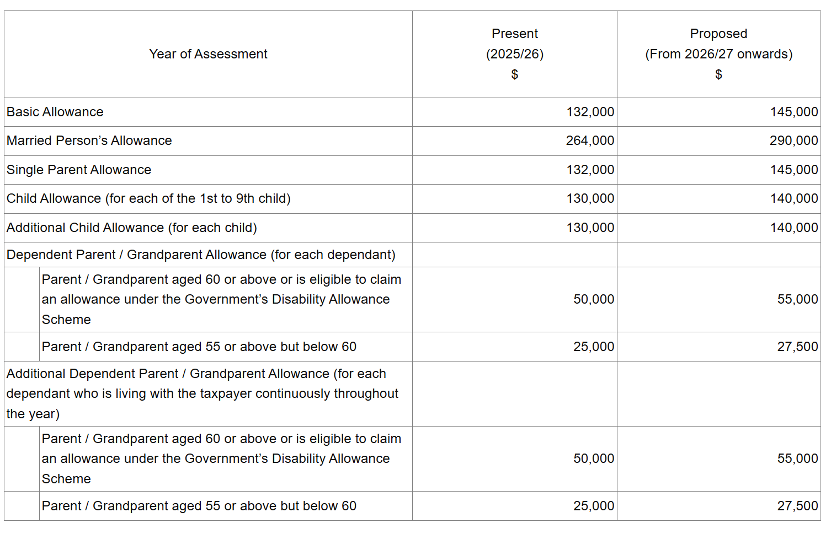
Conclusion
It is not hard to see from this budget that the Hong Kong government is actively responding to the concerns of global talent regarding the cost of living and is continuously optimizing the tax costs of enterprise operations.
For investors, every update in policy means there may be room for optimization in the original tax structure. Whether it is expanding the coverage of Profits Tax reduction by adjusting the company's legal entity structure, or strategically offsetting losses between different investment portfolios using ‘Personal Assessment,’ professional tax planning can save you real money under the premise of compliance.
As your one-stop business partner in Asia, Hongda Business Services will continue to monitor the latest legislative progress for you. If you are considering optimizing your business structure in Hong Kong, please feel free to contact our consultant team. We will assist you in achieving the maximization of asset protection and tax efficiency in this vibrant international financial center.